
The Map of Your Life: Evolving Views on Marriage in the Works of Taylor Swift
For 20 years, I've read Taylor's life like it's my tea leaves. Is the Travis Kelce era where our paths finally diverge?


“Do you think Taylor and Travis will break up?” I asked, flopping down onto the enormous sofa one night, where my boyfriend was watching football on the wall-size TV. I didn’t need to give any segue; I was talking about old friends.
“Yes,” he said, almost automatically, without even so much as looking over at me.
“What a shame,” I said. “Because you know whatever happens to Taylor, happens to me too. So that means you and I are going to break up,” I said.
“We are not going to break up,” he said, and he lifted his arm so I could crawl beneath it against him.
I was only partly being playful. In the last twenty years, I had come to read Taylor’s life like it was my tea leaves, my coffee grinds. As if my fortune could be found inside.
This boyfriend, for example, was the tall, red-bearded, sports-loving boyfriend who followed the Matty-Healy-esque madness of my last relationship. I was surprised he didn’t see the parallels. I was surprised he wasn’t rooting for Travis, because rooting for Travis was rooting for us.
Early Interpretations & Idealism
I have been a Swift fan since mid-2007. Not the earliest, but certainly very early on in her career. I fell in love for the first time that summer, both with Taylor and with a boy from summer camp, and I blasted “Our Song” so often that my sister still can’t listen to it. And since then, our lives have bumped along similar trajectories. She is the Virgil to my Dante, walking ahead of me with the lantern, so that I might see the way.
For anyone who has followed Taylor Swift’s career, there is a kind of narrative thread that runs parallel to her career and to her work, which is her search for true, lasting love. It began early in her teenage writings, and it has continued as her evolving views on love and marriage become more complex.
On the Debut album, the first mention of marriage comes in “Mary’s Song.” This is one of the few instances in the early albums where a narrator is clearly not a stand-in for Swift, since it’s the story of two people who meet when they are children, presumably as neighbors, and grow up together. They get married: “Take me back to the time when we walked down the aisle / the whole town came and our mamas cried, / You said, ‘I do,’ and I did too,” and they grow old together in the course of the song.
Marriage, at this point, is idyllic in Swift’s world. It’s the pinnacle of romantic love, the height of all connection, it’s the action that seals the meaning of true love. This trend continued on the next album, Fearless, written when Swift was in her late teens and released in 2008, when she was still eighteen.
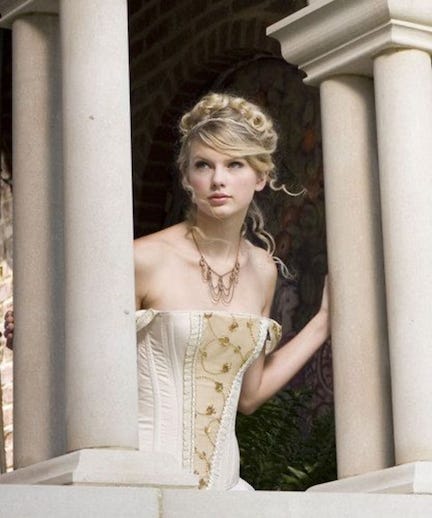
The first single from Fearless was “Love Story,” Swift’s big breakout hit and still one of her best-known. The sweeping bridge brings the love story to fruition with a love pronouncement and an engagement at once, the swell and height of the song leaping into marriage: “He knelt to the ground and pulled out a ring and said, ‘Marry me, Juliet, you’ll never have to be alone / I love you and that’s all I really know.’”
Juliet “pick[s] out a white dress,” and the rest is history. As it has often been said, she rewrites Shakespeare’s tragedy to have a happy ending.
Marriage as Disillusionment and Revenge
There are other, more realistic portraits on Fearless of marriage, however. In “Fifteen,” she sings, “Back then I swore I was gonna marry him someday, but I realized some bigger dreams of mine.” It’s clear that a wedding would be delightful, but a marriage would hold back the narrator and prevent her from achieving her career goals. Even at eighteen, there are disillusionments, questionings, the understanding that with love comes loss, that maybe a ring isn’t in fact what she’s been after.
Speak Now featured a wedding in its title track, but from a spectator’s point of view. No longer putting herself directly in the point of view of the bride—as she did in “Mary’s Song”—Swift begins to consider other perspectives. The revenge of “Speak Now,” where the bridezilla is forsaken for the charming and flawed narrator, suggests a shift away from marriage as it was even just a few years earlier, in Swift’s fantasy and fairy tale stage.
But after Speak Now, there are long absences in the talk about marriage, even in story form. From the release of Red in 2012 through the end of the 1989 era in 2017, there are few mentions of forever love and a heavier focus on heartbreak, but Swift is relatively quiet on rings, engagement, or marriage as a concept. After this long silence, elongated by her “cancellation” that led to delaying the release of her next album almost a year, reputation spoke quietly about a new kind of love. “Delicate” was a whisper, hardly daring to ask: “Isn’t it?”
And then, in “King of My Heart,” she finally says it: “Is this the end of all the endings?”
A Quieter Love: The Joe Alwyn Era
On this album, released in 2017, her new love was Joe Alwyn, the blonde, quiet, serious actor from England, and their relationship was more hushed than any of Taylor’s relationships before. Yet reputation was marked with these delightful love confessions that felt like she was on the precipice of something deeper, something more real.
Whereas her past loves had easily fit into the tropes we know of men, here was a man who was more complex. He was an artist. He was different, and their love was different too. “Call It What You Want” captured the difference: “I want to wear his initial / on a chain ‘round my neck / Not because he owns me / but ‘cause he really knows me.” This love wasn’t loud, didn’t beg for attention, didn’t feel like a Maserati down a dead-end street. It was a simple chain, a single letter. Elegant. True.
I had my own Joe relationship. He was also blonde, and quiet, and our love was quite different than any I’d had before. An older woman friend said to me, wisely, “You don’t have to choose a partner who’s loud and extraverted like your mom and your siblings. You can choose someone quiet, who likes to read. Someone more like you.” And that was my Joe-person.
We were at the right age to get married, and ready, and my Joe-person even proposed to me, fishing into his shirt pocket for a little gold ring in a little public park. All my friends were getting married, and I wanted to be married too. This was shortly after Lover was released, an album that, on the title track, contains a kind of marriage vow: “Ladies and gentlemen / will you please stand? / With every guitar string scar on my hand / I take this magnetic force of a man,” she sings. We were back, together, on the path to talking about marriage.
I didn’t know, at the time, how much my friends’ marriages would change our lives. I didn’t know how we’d get siloed into our suburban homes, and how I’d see them less and less. I was still sleeping in the twin-air-mattress on the floor, while they graduated to the marriage beds. I felt so outside of their grown-up lives, but I thought that if I married my Joe-person, I’d join their ranks. At least, if I couldn’t see my friends, I’d have a husband, which would mean I wasn’t alone.
While I felt like I was losing my friends to their marriages, I didn’t lose Taylor. She faced the same questions I did. She could have married Joe. Lord knows she wrote about it enough, wondering if their love was really it. “This is what you guys are all talking about, right?” she seemed to be asking, as “Paper Rings” turned into a golden “invisible string” when folklore was released in 2020. Isn’t this why everyone is always dressing up so fancy and proclaiming their love to the world? Engagement photos and save-the-dates and making me spend all that money on a bridesmaid’s dress? When’s it going to be my turn?
I did not marry my Joe-person. I lived in his apartment, surrounded by his books and telescopes, and I was unhappy. The loneliness I felt inside of our supposedly “quiet love” was destructive.
Complex & Historically Questioned: Marriage on Midnights
When Taylor and Joe announced their split in early 2023, it had been long-speculated by some of the lyrics in her songs, especially on Midnights. “Lavender Haze” opened the album and openly criticized marriage as a limiting and binary choice for women: “All they keep asking me is if I’m gonna be your bride,” she sang. “The only kind of girl they see is a one night or a wife.”
Taylor, who had long been the champion of losing yourself in love, who had always fought for the value of loving like you’d never been hurt, was calling out the hypocrisy of the tropes, saying there was room for more complexity for women in relationships. Women don’t have to be married to be valid. Relationships are a spectrum; they can be more than a one-night-stand, and less than marriage, and still matter. She was six years into her relationship with Joe, calling for people to stop asking when she would get engaged, as if it were her only accomplishment. As if she hadn’t conquered the music industry and all the world.
Taylor-narrator further went on to boastfully shirk marriage, notably on the track “Midnight Rain” when she sang, “He wanted a bride, I was making my own name, chasing that fame,” once again rejecting marriage for bigger goals, just as she had in “Fifteen.” In fact, much of “Midnight Rain” wrestles with this idea that the marriage would have prevented the narrator from achieving her greater goals. A bride is part of a wedding, which is meant to be positive, but it leads to the marriage, where the woman will be held back.
She also wrote “Bejeweled,” which, although it makes no direct references to marriage, is a full metaphorical conceit, essentially claiming she is her own diamond, and that without a ring, she can “pretend [she doesn’t] remember” if she has a husband or not. The lack of ring is, in fact, essential to her freedom.
On a subsequent release, “High Infidelity” also speaks of marriage as limiting: “Good husband, bad omen / dragged my feet right down the aisle / At the house lonely, good money / I’d pay if you’d just know me.” This narrator, married to a man, finds that marriage is not the rosy portrait it was painted to be. It’s limiting and lonely.
Many of the songs on folklore and evermore didn’t correlate exactly with her life in the way that Swifties had come to expect from her work. We had to read into songs like “champagne problems” to see that there are other sides of marriage proposals, where things can go terribly wrong. She was no longer imagining the narrator into the hero she had been in “Speak Now,” saving a man from a terrible woman, its own form of misogyny. Here, she was comfortable with accepting that she could also play the villain. It was less of a fantasy about a woman being chosen, and more of a fantasy about a woman choosing herself.
There are also many examples of disgruntled wives on evermore. Songs like “no body, no crime,” “tolerate it,” “happiness,” and “ivy” all portray the downsides of choosing marriage for women, from divorce to murder. None of these songs specifically align with the Taylor-narrator, but they complicate the understanding of marriage from a listener’s perspective. They show more realistically that marriage is not always happily-ever-after, and in fact it often contains domestic violence and power dynamics that subjugate women. evermore was realistic about this fact.
Reverting to the Old Illusion: Marriage in the Matty-Healy-interpretations of TTPD
After her official end of the relationship with Joe, we heard were rumors that Taylor was back with Matty Healy, an old flame from several years earlier, the singer of The 1975. I did this too: escaped my safe, quiet, serious lover and ran to an old lover, where the flame had not gone out. I needed someone who could light me up and make me feel alive again. Light me up—until I was on goddamn blaze in the dark.
This was my Matty-Healy person.
When I first met my own Matty Healy, playing darts at a bar, when I was twenty-five, he guessed I was a writer. “And a good one, too,” he said. “I can tell. I’ve met a lot of people, but you’re going to be famous one day.”
This man didn’t live within the confines of society. My earliest memories of being with him are riding around in his truck, where he let me throw my trash–orange peels, pistachio nut shells–on the floor. He also ate king-size Kit-Kats, which he bought at the gas station. “I didn’t know you were allowed to buy full-size candy bars and eat them all at once,” I said, watching him open one package after another, tossing the wrappers on the floor with abandon, devouring the chocolate. I could have made a single Kit Kat last a week, taking off little bites one at a time after dinner. He didn’t even bother to break them into parts.
“You follow too many rules,” he said. His British accent and the Kit-Kat made it sound like he had marbles in his mouth.
And that was him, breaking all the rules. Eight years later, he didn’t live like anyone else I knew. There was a pandemic, but he didn’t live in it. He did whatever he wanted, and he brought me with him. After living through a soul-death, I was exploding into life.
A friend texted to say she thought it was disgusting that Taylor would get back together with Matty. That he was “worse than Trump,” and that she wished she could have seen Eras before Taylor and Joe broke up.
I said, “Maybe you should sell your ticket.”
And when I mapped this conversation over my own life, I read it as: You should never have left the desolate hellscape that was your life with the Joe-person, so we could all be more comfortable. I didn’t believe in it. I didn’t believe in staying in unhappy relationships with men just because they were supposedly good or right for you. I believed in chasing dreams. I believed in Taylor.
And I said, “Well, I don’t think it’s fair to judge the quality of her performance or her songs on her dating life.”
And she said, “It’s really telling how you are not fazed.”
I said, “It’s always been Taylor for me. I trust her judgment no matter what. It’s been sixteen years, and she hasn’t let me down yet. I’m keeping my bet on her.”
A beat. I wrote again: “It’s not really up for discussion for me.”
She never texted me again, but she did go to the Eras Tour, after all that. I had unfollowed her by then, but I stalked her page just to fume about it, how she wrote this long, heartfelt post about having been with Taylor since the beginning. Fairweather fan, I thought. She didn’t trust Taylor, not like I trust Taylor.
I was also, in the wake of ending my engagement, really questioning what I thought marriage meant and whether I thought it was right for me at all. That friend, in particular, was married and had three children. She knew nothing of what life had been like for me, nor I for her. Marriage and kids continued to drive a wedge between me and the people I was closest to.
I felt, like some of Taylor’s narrators, that I had been sold a lie about marriage as a panacea for loneliness. I had never been more lonely than during the pandemic, as the narrator of “High Infidelity” had described. There were power dynamics at play, like the disgruntled wives of evermore experienced. Joining my life with a man’s was not going to be a cure-all solution for me. I needed more than to think that I could reverse Romeo and Juliet and live a happily-ever-after.
And Taylor did too. She released “You’re Losing Me,” in which the narrator rejects marriage before she can be rejected by it: “I wouldn’t marry me either / pathological people-pleaser / who only wanted you to see her.” If the narrator can call out her own faults so publicly, perhaps it hurts less, to feel rejected. Fans felt that this song was the glimpse into the end of the relationship with Joe, the ask for marriage that was denied, or, simply, the recognition that this was not the forever-person. The disillusionment around marriage, started with Fearless and revived on Midnights, was growing into critical thinking.
By the time The Tortured Poets Department was released in the spring of 2024, I knew what happened when you stayed with the tortured, torturous former lover. There are times on TTPD where Taylor laments losing the storm of a person who inspired this album, when she is angry at him for leaving her in the night. But I knew what could happen when he didn’t leave; I had lived it. I followed that rabbit hole all the way to the end. Taylor’s fall back into the hedge maze lasted three weeks. Mine lasted three years.
I had started out so certain, returning to the promises made to me when I was 25, like the ones Taylor mentions on TTPD. Unlike on Midnights, we were seeing a return to the marriage-as-fruition belief of the earlier albums. She writes in “loml” about “talking rings and talking cradles,” and “You and I go from one kiss to getting married.” She also describes how the lover “takes [her] ring off [her] middle finger / and puts it on the one / people put wedding rings on,” on the title track of the album. The narrator of this song says, “And that’s the closest I’ve come / to my heart exploding.”
The part of her that waited so long for a proposal was now screaming to go faster, to run headlong and get caught up, believe in love like you did when you were young and crazy. Enough with playing it safe; enough following the rules. On “But Daddy I Love Him,” she describes a relationship that is frowned upon by everyone in the town, ending with a wedding. “And now I’m dancing in my dress in the sun,” the narrator sings. But the wedding isn’t all roses; there are thorns, and in fact, the wedding is used as a weapon against the formerly disapproving neighbors: “Time, doesn’t it give some perspective? / And no, you can’t come to the wedding / I know he’s crazy, but he’s the one I want.” The chaotic lover led us back down the path of pettiness, to the “Speak Now”-esque use of wedding-as-revenge.
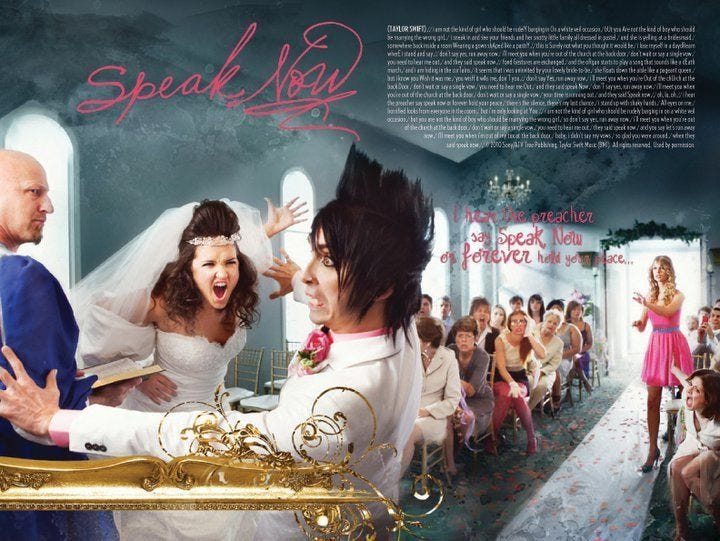
The writing, the story, was evermore sophisticated and well-told, but the view of marriage was a reversion, a retreat to her teenage desires. “But Daddy I Love Him” has been described as a grown-up “Love Story,” but in some ways it’s much younger, because it’s more spiteful. At least “Love Story” believed in itself. “But Daddy I Love Him” is a kind of childish delusion about how men can change, tamed from chaos and wild into good husbands.
The Secret Wish and Longing: When Your Lovers Turn Your Desire for Marriage or Children Against You
Taylor’s albums have also reckoned with the atrocities committed in the name of marriage, the selling off of women to other families. It was mentioned in a song written as early as 2010, “Timeless,” which imagines the narrator being “forced to marry another man,” and as recently as on TTPD, with a line from “I Hate It Here”: “I’d say the 1830s / but without all the racists / and getting married off for the highest bid.” This line has its problematic interpretations, and I agree that its unfair to compare marriage to slavery or to invoke slavery simply to imply anti-racism. Compared to other descriptions of marriage in her oeuvre, however, I appreciate the realization that marriage has only recently become this self-expressive act, and it has subjugated women for thousands of years.
And yet, there were so many echoes of Taylor-narrator’s own desire for marriage on Tortured Poets, that recognition that as harmful as marriage can be as an institution, and as Taylor-narrator grew up and knew she was bigger and better than that and still the narrators inside of her wanted that ring. They wanted to believe in the cradles and the strollers and that love was real and it didn’t have to be hard and maybe you’d gone all over the world and found that you already knew the person you loved. “Everyone we know understands why it’s meant to be / ‘cause we’re crazy,” she sings, on the title track.
It’s so hard to be a grown up sometimes, and you just want this little reprieve, you just want this one little thing to turn out to be magical. And it turns out love isn’t like that. It’s probably just boring old showing-up-for-each-other and all that. But it could have been different; it was so close.
My own Matty-Healy-person was also English, and took me to England to meet his family. Around Christmas, he started to push suddenly for marriage. We didn’t have to tell anyone, he said. It felt romantic, in a way. We spoke to a Justice of the Peace who suggested a spot by the river, and it was midwinter, and I thought of the icicles in the trees and maybe I’d wear my pretty soft pink coat, and maybe I would wear thin, gold jewelry, and maybe we’d be happy. He even told my mom he had proposed to me on Christmas, although it was not technically true.
Here was the thing: despite everything I knew about marriage as a sexist institution that has historically subjugated women, and despite my own ambitions and feminist leanings, this was still a weak spot for me. I wanted him to want to marry me; I wanted him to say it. I wanted him to want children with me. I wanted to feel–felt, even for a time–that I was part of something greater than myself, like a family, and that I was entering a relationship that was taking ownership and accountability for me. That I wasn’t going to be alone in the world anymore.
In fact, it seemed that I so badly wanted to be married that I had invited all these proposals into my life. I had gotten the Joe-person to propose. And then I left my Matty-Healy person within days of the date we were supposed to have our small winter wedding. I kept getting so close, and then pulling away. I said I wanted it, but then faced with it, I was so unsure. Marriage, frankly, seemed like a bad idea, tying yourself to a man like that. The way it had driven my friends into their homes, with their husbands—I resisted. It felt isolating, and I was fearful of being alone. Like the women of evermore, I felt fearful of what lied ahead, beyond the happy days of the engagement and the wedding. Marriage to a man felt fraught with fear.
I didn’t know if I wanted to be married, but I knew I didn’t want the calm and quiet loneliness of the Joe-partner, and I didn’t want the chaotic extreme of the Matty-partner. I needed Taylor to show me the map.
In my chaotic relationship, we had also tried for a baby, but to no avail. Most of my friends had children by now, and I thought, If my friends and I would all grow apart because they had husbands and babies, then I should probably have a baby too. At least then, if I’m lonely, I’ll have a baby.
The Taylor-narrator speaks of the desire for a child on TTPD, in “loml,” and, (who can forget?) the screaming “I’m having his ba-a-by!” of “But Daddy I Love Him,” although of course this line is meant to be playful. In “The Manuscript,” the final track on the album, the narrator describes a relationship between a younger woman and a much older man, one who says, “He said that if the sex was half as good as the conversation was / soon they’d be pushing strollers / but soon it was over.” The rhyming of “strollers” with “over” is a strong connection between the promise for children and a future that ends abruptly in this song. While The Manuscript arguably reflects more on the era of the Red album, resembling, as it were, the ending of the “All Too Well” video, there’s the invocation of children, specifically, in a new way throughout the album, a way we had not seen the Taylor-narrator address directly before.
Perhaps wanting children is either too obvious a desire—assumed that all women want it—or too tender a wish, something you guard from your lover, so he does not use it against you. Men have to be either really willing or really manipulative to invoke giving a woman a baby, and it makes you very vulnerable to admit to wanting one. This mention, speaking to a young narrator, shows that early wish in a woman to be united with a husband and to have a child together.
There were parts of The Tortured Poets Department that so closely resembled my leaving my own chaotic relationship that friends actually texted to say it was uncanny. Oh, but of course. We have always been so connected. So many people were critical of TTPD, and I absolutely did not care because I knew it was written for me.
Maybe there’s some kind of Malcolm Gladwell explanation for it—maybe all girls, born in the late eighties, who have blonde, curly hair will grow up to experience the predatory behavior of older men. Perhaps there are statistics on how many lovers you have before you settle down when you’re a woman in your thirties in fifth wave feminism. Of course, the pendulum swings, from the safest lover to the most chaotic one, trying to find your balance. It makes perfect sense, maybe, if you want to look at it up close. Maybe there’s a better explanation than cosmic connection, but I don’t want one. I want our Sagittarian suns, written-in-the-stars, she-cares-about-me-more-than-she-cares-about-you explanation.
Hyper-Hetero: the Travis Kelce Era
Taylor and I both emerged on the other side of it, somehow. We both reclaimed personhood and started to find our way again.
And then we both found our way into the arms of tall, red-bearded men who loved to play sports.
I thought about it one morning, when I woke up in the endless ocean of white sheets in the new boyfriend’s bed, my own Travis-Kelce-boyfriend. He had a red beard and green eyes, and when we made love he watched me with intent, his mouth gaping sightly to mirror my own astonishment at the depth of this pleasure, his eyes holding my gaze without flinching, without fear. “This perfect body,” he whispered. “I love this perfect body.”
And me, spent, splayed over him, no tension, no fear: “This is the safest I ever feel.”
He got up and went into the shower. He was an everyday shower person. Twice a day, even. I was once every two days at best. He was so consistent in so many aspects of his life. Just getting up, having his shower, brushing his teeth, not running. It was enough to make a purely feminine being, such as myself, one who shows signs of ADHD but not enough to be medicated, really melt away.
Melting–that’s what I was doing, in the bed, watching him. This is the safest I ever feel.
I wondered if Taylor felt this way, in what was surely the ocean of a bed where her lover slept in his professional-athlete-sized body. I wondered if she ever thought, like I did, about the fact that you can have a lover who is quiet and intelligent and blue-eyed and it won’t be enough for you because in the end he would choose his books over you, and you won’t feel free. A beautiful cage, still a cage.
And you can go back to the chaotic extreme, the love you thought you wanted at twenty-five, and find that it’s an illusion, and it wasn’t safe there either. All those false marriage proposals, marriage mirages. Future faker, baby-promiser.
And then you find yourself with a man who is something else. For a few months, I had this feeling like it was all going to go so well, like I was fated to this, because of Taylor.
Here was a regular guy: he wore a lot of hoodies and basketball shorts and we ate a lot of bar food, and we laughed—he was very funny—and we went to the drive-in and to the beach. He wore baseball hats.
He was American pie, and sportsball, and brushing his teeth at the counter. He drove a Hyundai Palisade. He loved Dave Matthews Band. He told me about basketball, that he could have been as good as Cooper Flagg. He said, “I could have been really great. If I’d had my brother’s height and talent, I could have been really great.”
I touched his beard and said, Oh, but baby, you are.
Did Taylor feel this free, in the arms of the biggest, strongest lover she’d ever had? Sure, Matty was scrappy, and he could move heavy things like a puppy would move them, by tugging at one side and then the other. But he wasn’t like this. He didn’t have the strength of this lover, whose real strength was in his never-quit, in his head-down follow-through. Dogged, American, bootstraps, go-getter.
After so many years in England, it was so good to return to an American love. I felt it, and I saw it on Taylor’s face when she watched football, like she had sparked again some kind of fire. This was a good boy, one who reminded the Taylor-narrator of being a teenager, with the release of “So High School.” I was desperate to know, Taylor—is this it? Are your new songs going to tell me that after all this searching high and low, near and far, we come home and find it was waiting here all along?
Tell me the future, Taylor. Show me the path. What comes next for us, women in our mid-thirties who know that marriage isn’t everything and weddings and babies don’t solve your problems but still, sometimes, just wish?
So when I flopped down on the couch that night, and he told me that he thought Taylor and Travis would break up, and I told him he was sentencing us to the same fate, he dismissed me.
But of course we did break up. And I tried to have integrity, and I tried to say what wasn’t working for me, but the truth was that we weren’t right for each other. I didn’t think I wanted to be with a man at all. Men, heterosexuality, not all its cracked up to be. Not offering me the complexity of relationship and the ability to grow that I want. I’m not the woman I want to be, when I’m with a man. All this striving for marriage, for what?
After our break-up, he reached out to me by sending the Spotify link to “loml,” with absolutely no other context. I was annoyed by this, because of course he was not the person I thought of when I thought of “loml.” But that is besides the point.
I sent him a voice message back: “We don’t know what Taylor thinks about me and you because we don’t have the Taylor and Travis break up album yet,” (of course, I took the bait). But he was the one who said they would break up, and of course, that’s why we broke up too.
Yet his prediction for Taylor and Travis does not come true. The longer they continue to date, I begin to wonder if this is where our paths diverge forever. After all, I’ve always wondered if Taylor would get married, and have babies, and grow a garden, and leave me behind. Her songs will change, and Taylor will be yet another friend I lose to marriage, one who grows up while I stay single and stay childlike, on the twin-sized air mattress on the floor while she upgrades to the big bed, like a real couple.
Maybe our paths already diverged, and I don’t know it yet. I have already known for a while I can’t have babies, so parenthood, if it comes to me at all, will look quite different. Will this separate me and Taylor too?
In the Travis-Kelce-era, we return, again to “Mary’s Song,” the first mention of marriage in the Taylor Swift canon. And now it is layered with so much special meaning: Taylor’s use of the “87” for Travis’s football number, and “89” for her own birth year. It seems almost perfectly full-circle, and all I wish for her is happiness, and, if she really wants, to push a stroller or rock a cradle, too. Of course I want that for her. For all she has given to me these last twenty years, I want her to have anything she wants.
But I am scared, too, by the thought that if she has children, it will pull us away from each other, our lives no longer a mirror, our connection no longer sacred. If she chooses to be with a man, and have children, and I make a different choice, or have a different life, how will I be able to read my future in the tea leaves of her music?
I am kidding. Well, half-kidding.
And in spite of my very personal interpretations in this essay, we can see how the Taylor-narrator has made marriage an increasingly-complex concept on her albums throughout time. From the early days of weddings as dreams, to weddings as scenes of revenge, Taylor covers the spectrum through her extraordinary career, even as her life does not answer this question.
Perhaps it’s best summed up by a song I have not mentioned yet: “imgonnagetyouback” in which the narrator sings: “Whether I’m gonna be your wife or / gonna smash up your bike I / haven’t decided yet.”
While we wait, and wonder, and wish to know about that decision, I hope in some ways for an ending, to answer the question that began Taylor’s career in 2007: will she find the forever-love she seeks?
And selfishly, I hope against it—for as long as our forever-yearning spirits reflect each other.